
Backyard swimming pool ideas for Australian yards, with budget and space for each
The right backyard pool idea is the one that fits your yard, your budget and your state's safety rules at the same time. Photo galleries show the finished look but skip the parts that decide whether an idea will work for you: how much room the fence and equipment need, what pushes the price up, and which approvals apply. This guide tags each idea with those details, so you can shortlist one or two and then get real numbers from a pool builder before you rule a pool in or out.
How to read these ideas: type, footprint, budget drivers and approvals
Each idea below is tagged with its pool type, footprint, budget drivers and likely approvals. There are no dollar figures, because prices move with site conditions and inclusions, and an honest number only comes from a site visit and an itemised quote. Our pool cost guide explains what drives the price.
| Idea | Pool type | Footprint | What drives the budget | Approvals to expect |
|---|---|---|---|---|
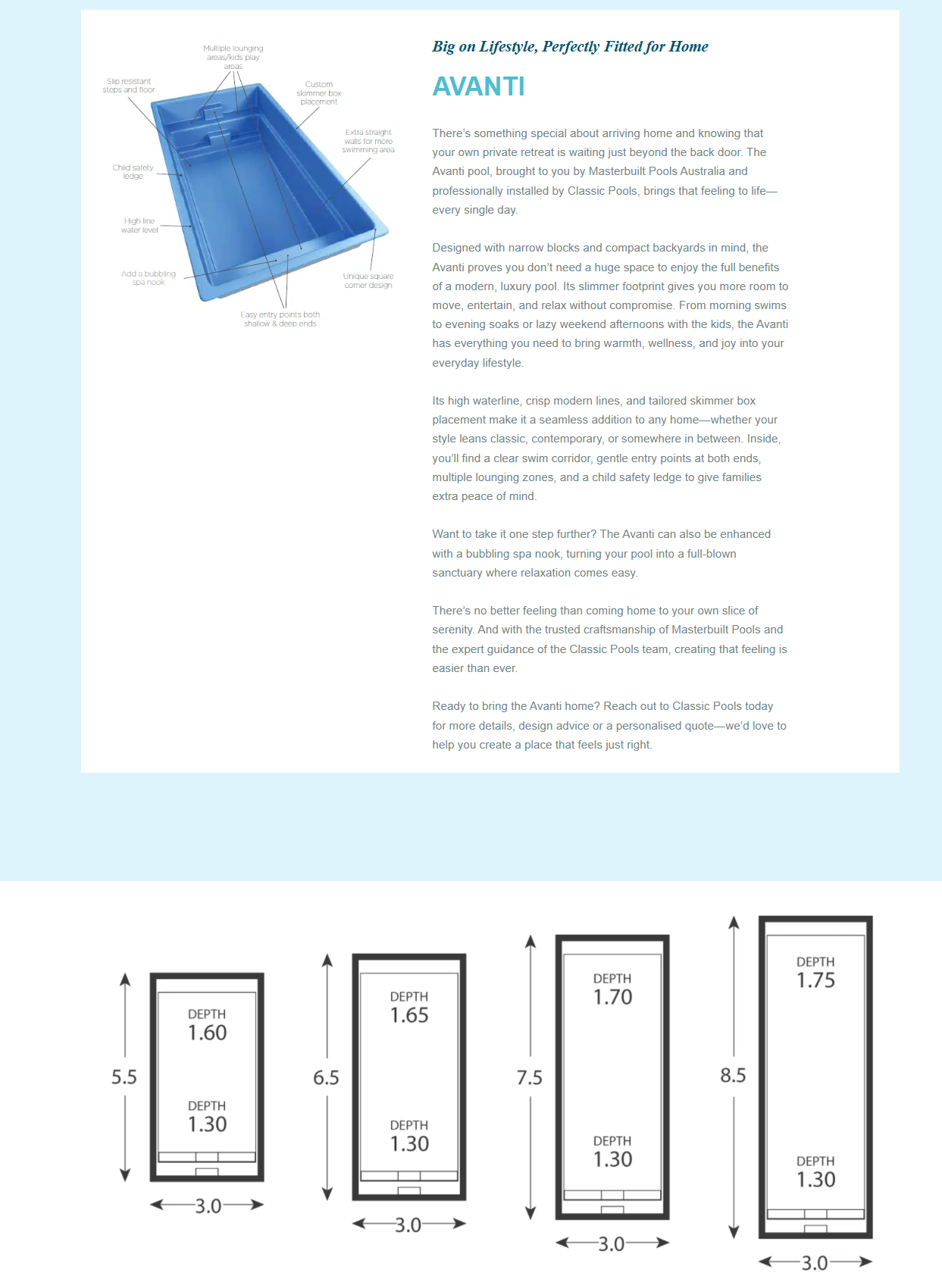
| Compact pool in a small or narrow yard | Small fibreglass or plunge-style shell | Smallest, but fence clearances still apply | Access for machinery, excavation, fencing | Building approval, compliant barrier, registration where your state requires it |
| Above-ground or semi-inground pool with decking | Above-ground pool | Small to medium | Decking, levelling, barrier around ladders and access points | Same safety barrier rules as inground pools once water can exceed 30cm |
| Family pool with shallow areas | Fibreglass or fully tiled | Medium to large | Size, depth, surrounds and landscaping | Building approval, compliant barrier, registration |
| Pool on a sloping block | Any type, often partly raised | Varies with the slope | Retaining, engineering, rock in the dig | Building approval, possibly an engineer's structural report |
| Custom or fully tiled design | Fully tiled or custom panel | Shaped to the site | Design detail, finishes, size | Building approval, compliant barrier, registration |
Ideas for small and narrow yards: go compact and plan the fence first
A small or narrow yard can still fit a pool, but the fence and clearances use more space than most people expect, so plan them before you choose a shape. The Queensland Building and Construction Commission (QBCC) says pool fences need continuous 900mm non-climbable zones, and for fences under 1800mm high, climbable objects must sit at least 900mm from the outside and 300mm from the inside.
Ideas that suit tight yards include a compact rectangular shell set parallel to the back fence, or a plunge-style pool for cooling off rather than lap swimming. If a boundary fence will form part of the pool barrier, NSW requires that section to be 1.8m high, which can shape where the pool sits. Ask the builder to draw the fence line on the site plan before you settle on a size.
Above-ground and semi-inground layouts with decking: yes, they can look built in
An above-ground pool can look like part of the garden when it is wrapped in decking, partly sunk into the ground or framed with planting. If budget is the barrier, ask for an above-ground quote alongside an inground one. The City of Salisbury in South Australia notes that the walls of an above-ground pool can serve as the safety barrier if they meet Australian Standards AS 1926.1 and AS 1926.2, including a barrier permanently fixed around ladders and access points.
Decking changes the safety picture, though. The QBCC lists deck ledges among climbable objects, and where a fence relies on an inside non-climbable zone, nothing at its base, such as a deck, may reduce the 1800mm inside height. Above-ground does not mean exempt either: in NSW, portable pools that can hold more than 30cm of water face the same fencing and safety rules as permanent pools. Ask how the deck and barrier work together when you price above-ground pools.
Family pools: put supervision and sightlines ahead of features
For a family pool, the strongest design choice is a pool you can see from inside the house. Western Australia's building regulator advises locating the pool so it can be easily seen from the house, and says supervision of young children is the most effective way to prevent drowning, with safety barriers a secondary measure only. The same regulator notes that drowning is a leading cause of accidental death for children under five, and that most of these incidents occur in swimming pools.
Once sightlines are settled, the fun parts follow: a wide entry step or bench where little ones can sit, a shallow area for play, and paving or lawn for drying off and family time after school. The QBCC also says to plan the pool so there is no direct access from doors and windows. Ask each builder which shells or designs include steps, benches or shallow zones, and how deep the water is at each end.
Sloping blocks and tricky access: possible, but budget for engineering
A sloping block can take a pool, and a partly raised pool on a slope can open up views, but expect more groundwork and approvals than on a flat site. According to the QBCC, your certifier will tell you whether you need an engineer's structural report when you are building on a difficult site. Fences on sloping or stepped sites must also be at least 1200mm high at every point along the fence, which affects how retaining walls and steps are designed.
Excavation is where surprises cost money. The QBCC recommends that a pool contract include provisions for unforeseen events, such as finding rock during excavation or wet weather. Tight side access matters too, because it affects how machinery and materials reach the backyard. Ask every builder for a site inspection rather than a quote from photos, and ask which costs are fixed and which depend on what the dig finds.
Custom and fully tiled designs: when bespoke is worth it
A custom or fully tiled pool is worth considering when a standard shell will not fit the yard, or when the design has to line up with the house, a deck or a boundary. Standard shells come in set shapes and sizes, while a custom design is drawn to the site, so you get more control over shape, depth, finishes and features, and a quote that depends heavily on those choices. Classic Pools offers fully tiled pools and custom swimming pools alongside its inground fibreglass ranges.
The QBCC suggests discussing shape, location, interior lining, size, depth and accessories with each builder, and confirming exactly what the price includes, such as pool surrounds and landscaping. That matters more with a bespoke design, because two quotes for a similar looking pool can include very different work. For colour and finish ideas, see our guide to swimming pool colours.
Plan the fence and services into the design from day one
The fence, pump and filter shape a backyard pool as much as the pool itself, so put them on the plan before you choose finishes. The QBCC advises considering the pool safety standard when positioning the pool on the block and planning the fence and landscaping. Use this checklist with your builder:
- Mark the fence line, the gate and the 900mm outside non-climbable zone on the site plan.
- Place the pump and filter where children cannot climb them to get into the pool area.
- Check where boundary fences form part of the barrier, and how high they need to be in your state.
- Keep trees, shrubs and garden beds clear of the fence. The QBCC says to trim any branches within 900mm of the pool fence.
- Western Australia's guidance is to avoid locating other structures inside the pool area.
- Confirm who handles electrical and plumbing connections. In Queensland, the QBCC says that work can only legally be done by licensed people, whatever it costs.
- Confirm who will arrange the barrier inspection and sign-off, which is a job for a certifier, building surveyor or council inspector, not the homeowner.
For planting and paving around the fence line, our pool landscaping ideas guide and the landscaping page have more detail.
Running costs, and who a pool is not right for yet
A pool costs money every month, not only on the day it is built, so weigh running costs before you commit. Energy Rating, the Australian Government's appliance efficiency program, says a pool pump uses nearly 18 per cent of the electricity in the average Australian home with a pool. It recommends the smallest pump suitable for your pool, and notes that a pump with more stars uses less energy and is cheaper to run. Add water treatment, maintenance and barrier inspections: in Western Australia, councils inspect barriers at least every four years and can charge for it, typically through the rates notice.
A pool may not be right for you yet if you rent, expect to move soon, cannot set aside money for ongoing running costs, or have no room for a compliant barrier. If that is you, getting an itemised quote now still tells you what to save towards. This guide is general information only, not financial or credit advice.
Your next steps
Once you have one or two ideas on your shortlist, read our guide to how much a pool costs to understand the price drivers. Then request a quote and ask for an itemised price that shows the pool, excavation, fencing, equipment and surrounds separately, so you can decide with real numbers in front of you.
Frequently asked questions
What trend is replacing swimming pools in Australian backyards?
We could not find official data showing pools being replaced by anything. Energy Rating estimates there are around 1.1 million backyard pools in Australia. Formats vary: smaller pools, plunge-style pools and above-ground pools with decking suit smaller yards and tighter budgets. Most still count as pools under the law, so barrier rules apply once water can be more than 30cm deep.
How much space do I need around a pool?
Allow for the fence and its clearances as well as the water. Under the Queensland pool safety standard, climbable objects must be kept 900mm from the outside of a fence under 1800mm high and 300mm from the inside. You also need room for the pump and filter, positioned so children cannot climb them, plus paving or lawn to walk on. A builder's site plan will show the real footprint.
Do I need approval for a pool in my front yard?
In most cases a new pool needs building or development approval wherever it sits, and above-ground or portable pools can need it too. Western Australia says all swimming pools and spas need building approval, and its barrier rules require the barrier to restrict access from the street, adjoining properties and the house. In Queensland, the QBCC notes that extra approvals can apply, such as town planning approval in a special zone. Check with your council or certifier before you design around a front yard.
How long does a backyard pool project take from design to swim?
The timeline depends on approvals, site conditions and inspections, so ask each builder for a written schedule. Some steps are set by law: in Queensland, a compliant fence must be in place before the pool is filled with 300mm or more of water. In Western Australia, councils must inspect a new pool's barrier within 30 days of becoming aware it is finished. In Victoria, new pools should be registered with council within 30 days of final sign-off.
Do I have to register my pool?
In several states, yes. Queensland requires a new pool to be registered with the QBCC once it is built. All NSW pool and spa owners must register on the Swimming Pool Register, and registration does not mean the pool is compliant. Victorian councils such as Maroondah say barriers must be checked and certified every four years by a registered building surveyor or building inspector.
Where can I see pool options near me?
Browse our gallery, visit a showroom in Brisbane (Loganlea), Adelaide (Holden Hill), Melbourne (Springvale) or Perth, and ask the team what you can see in person. Local pages cover above-ground pools in Brisbane, Adelaide, Melbourne and Perth. Judging size against a real yard layout helps before you commit to a design.
Sources
- Build a pool, Queensland Building and Construction Commission, https://www.qbcc.qld.gov.au/home-owner-hub/swimming-pools/build-pool, accessed 4 November 2026
- Pool fences, Queensland Building and Construction Commission, https://www.qbcc.qld.gov.au/home-owner-hub/swimming-pools/pool-safety-standard/pool-fences, accessed 4 November 2026
- Non-climbable zones, Queensland Building and Construction Commission, https://www.qbcc.qld.gov.au/home-owner-hub/swimming-pools/pool-safety-standard/non-climbable-zones, accessed 4 November 2026
- Register a pool, Queensland Building and Construction Commission, https://www.qbcc.qld.gov.au/home-owner-hub/swimming-pools/register-pool, accessed 4 November 2026
- Tips for finding a licensed contractor, Queensland Building and Construction Commission, https://www.qbcc.qld.gov.au/prs/node/7371, accessed 4 November 2026
- Swimming pool and spa safety barrier requirements, Government of Western Australia, Building and Energy, https://www.wa.gov.au/organisation/building-and-energy/swimming-pool-and-spa-safety-barrier-requirements, accessed 4 November 2026
- Owning a pool or spa: your obligations, NSW Government, https://www.nsw.gov.au/housing-and-construction/building-or-renovating-a-home/pools-and-pool-safety/owner-obligations, accessed 4 November 2026
- Swimming pools, City of Salisbury, https://salisbury.sa.gov.au/development/building-in-salisbury/residential/swimming-pools, accessed 4 November 2026
- Swimming pool and spa registration and fencing, Maroondah City Council, https://www.maroondah.vic.gov.au/Residents-property/Swimming-pool-and-spa-registration-and-fencing, accessed 4 November 2026
- Pool pumps, Energy Rating (Australian Government), https://www.energyrating.gov.au/consumer-information/products/pool-pumps, accessed 4 November 2026