
Swimming pool colours: how the shell colour changes the water you see
Last updated 4 November 2026 by the Classic Pools team. How we researched this guide is set out near the end.
A pool shell colour sets the base tone of the water, but the water changes how that colour looks. Water absorbs the red end of the light spectrum, so once a pool is filled the shell takes on a blue cast, and the cast shows more where the water is deeper. That is why a colour chip in your hand, or a dry shell, rarely matches the finished pool: judge any colour in a filled pool, at both the shallow and deep ends.
Key takeaways
- Water filters out red light, so a shell colour can pick up a blue cast once enough water covers it. The U.S. Geological Survey notes that the same water looks colourless in a bucket.
- Lighter shells give bright water and an easy view of the floor; darker shells give a deep, reflective look. Neither is better overall.
- We found no Australian source that measures how much a dark shell warms pool water. Pool covers are the better documented way to add warmth.
- Australian sun is strong almost everywhere in summer, so get the colour warranty in writing whichever finish you choose.
- We found no Australian survey of popular or trending pool colours, so choose for your own yard, paving and light.
- Pool colour does not change the barrier or safety rules.
Shell colour vs water colour: enough water depth adds blue
A pool shell colour looks different once the pool is full, so a chip or a dry shell is only a starting point. The U.S. Geological Survey explains that an indoor swimming pool appears blue from above because light reflecting from the bottom travels through enough water for its red component to be absorbed, while the same water in a smaller bucket looks colourless. The USGS adds that the slight blue tint of water shows most clearly through a long column of water, and NOAA describes water as acting like a filter that leaves the blue part of the spectrum. In practice, the deep end of a pool can read differently from the steps and the shallow end, even though the shell is one colour. The table below is general guidance on what to check for each colour family, not a measured result.
| Shell colour family | What to check in person | Where to look in a filled pool |
|---|---|---|
| White and very pale finishes | Glare on sunny days and how marks show on the floor | The deep end, where the blue cast is usually strongest |
| Light greys and sand tones | How it sits beside your paving and coping | The steps and ledges, where the least water covers the shell |
| Mid blues and mid greys | The difference between the shallow and deep ends | Both ends, viewed from the spot you will see the pool most |
| Dark greys, charcoal and navy | How easy it is to see the floor and steps | The steps and floor in late afternoon light |
Lighter or darker: neither wins outright, it is a trade-off
Lighter shells suit people who want bright water and an easy view of the floor; darker shells suit people who want a deep, reflective look. On heat, the honest answer is that we found no measurement for pools in Australia. The closest Australian data is for roofs: building rules rate roof colours by solar absorptance, the share of sunlight a surface absorbs, and BlueScope notes that a roof with a lower solar absorptance absorbs less heat than one with a higher solar absorptance. A pool shell sits under water, so treat that only as a general principle and be cautious of any promised temperature gain from colour alone. The heat figures energy.gov.au gives on its pool pumps page are for covers, not shell colours. Sun exposure matters for every colour: the Bureau of Meteorology reports that average clear-sky UV Index values of 11 or more cover virtually all of Australia in January.
| Factor | Lighter shells | Darker shells |
|---|---|---|
| Heat from the sun | Absorbs less of it (general principle) | Absorbs more of it, but the effect on water temperature is not well measured |
| Sun and fading | Ask what the colour warranty covers | Ask what the colour warranty covers, and how fading is assessed |
| Visible mess (check in person) | Look at how leaves and dirt show on a sample or filled pool | Look at how dust and pollen show on a sample or filled pool |
Most popular pool colours and current trends: no reliable data
There is no published Australian survey of pool colour choices that we could find. The pages we found that name the most popular pool colour, or the trending pool colours for 2026, were businesses' own marketing and social posts, such as pool builders and paint brands. Those posts describe what each business sells or promotes rather than what Australian households choose. A more useful test than popularity is fit: how the colour looks in your light, beside your paving, from the spot where you will see the pool most.
Matching colour to coping, paving and the house
The colour that works in a modern Australian backyard is usually the one that ties the pool to the hard surfaces and the house around it. Pool colour, coping and paving are seen together every day, so choose them as a set rather than one at a time. Use this checklist before you commit:
- Look at shell, coping and paving samples side by side, outdoors, in the morning and in the late afternoon.
- Test the undertone with samples: for example, see whether warm sandstone or cream pavers look better beside a sand or soft grey shell, and whether cool grey or charcoal pavers look better beside a grey or dark finish.
- Check the view from inside the house, where many people see the pool most often.
- Think about trees nearby: a pool under trees will collect leaves, and contrast decides how visible they are.
- Ask to see the colour in a filled pool, not only on a chip or brochure.
- Write down the colour name and range, and confirm it on your itemised quote.
For more layout and planting ideas, see our pool landscaping ideas.
Colour for fibreglass, tiled and above-ground pools
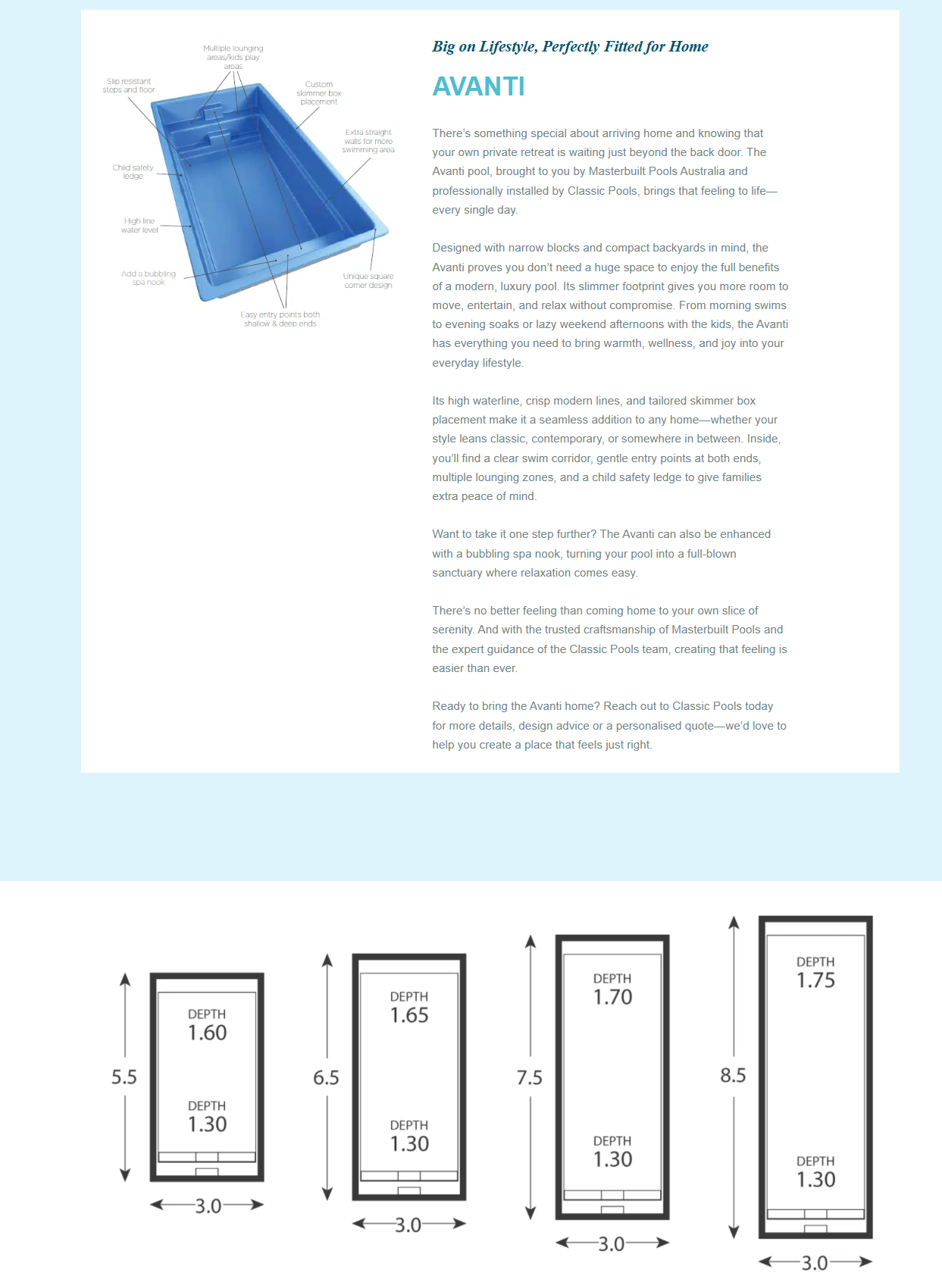
Each pool type sets colour in a different way, so ask about colour options when you compare types, not after. In a fibreglass pool, ask whether the colour is set when the shell is made, which colours each shape in the fibreglass range comes in and whether any colour costs extra. In fully tiled pools, the water tone comes from the tile and grout you select. For above-ground pools, the inside finish and the outside walls are both part of the look, so ask to see samples of each. Whatever the type, ask for the colour warranty in writing.
Before you choose a colour: who a pool may not suit yet
Shell colour is one choice inside a much larger purchase, and the costs continue after the build. energy.gov.au says pool pumps can be one of the largest users of electricity, making up around 18% of the electricity bill. A pool may not suit you yet if you plan to move soon, if your yard needs other work first, or if the ongoing costs would stretch your budget. If you are unsure, it still makes sense to get real numbers before ruling a pool out: an itemised quote that separates the shell or structure, installation, fencing, paving and equipment lets you see what is fixed and what can be staged later.
How we researched this guide
This guide was written by the Classic Pools team and last updated on 4 November 2026. We used Australian government and regulator sources where they exist (the Bureau of Meteorology, energy.gov.au and the Queensland Building and Construction Commission), a manufacturer's published data on roof colours, and U.S. government science pages for the physics of water colour, which applies anywhere. We looked for Australian data on popular pool colours, on how much shell colour changes water temperature and on how quickly pool colours fade, and found none we could cite, so the guide says so rather than guessing. The guide has no photos because we only use pictures of real pools, not stock images. For a specific shell colour, finish or warranty, get the answer from your builder in writing.
Frequently asked questions
What are the trending pool colours for 2026?
We found no Australian survey or industry data that tracks which pool colours are trending in 2026. The trend lists online are mostly businesses' own marketing, so they show what each business promotes rather than what households choose. A steadier approach is to shortlist two or three colours that suit your paving and house, then view each one in a filled pool in daylight. A colour picked for your yard will still look right after a trend moves on.
Does a dark pool really stay warmer?
Not in any way we could find measured. No Australian source we found tests how much a dark shell warms pool water, so colour alone is a weak plan for warmth. Covers are better documented: energy.gov.au says transparent bubble covers can cut heat losses from a heated pool by up to 75%, and translucent bubble covers can warm a pool by as much as 7 degrees. If warmth matters, price a cover alongside the shell.
Will my fibreglass pool colour fade?
Strong sun is a given across Australia, so the useful question is what your builder will put in writing. Ask for the colour warranty as a document and check what counts as fading or discolouration, how it is assessed, how long the cover lasts, and which care or water chemistry conditions keep it valid. How a particular shell colour holds up depends on its materials and care, so compare these answers across quotes rather than relying on a brochure.
Does pool colour change the fencing or safety rules?
No. Safety rules apply whatever the colour. The QBCC says Queensland pool owners are required by law to ensure their pool is fenced and meets the swimming pool safety standard, and you may need a safety certificate when buying, selling or leasing. In Queensland, barrier compliance sign-off is for a licensed pool safety inspector or building certifier: the QBCC says only a QBCC-licensed pool safety inspector can issue pool safety certificates. Other states have their own rules: check with your state regulator.
Why does my pool look green even with a blue shell?
Shell colour is only part of the look. The U.S. Geological Survey notes that water rich in algae usually appears green and that decaying plant matter can turn water yellow or brown. A green tinge in a pool can point to water care or filtration rather than the shell. Ask a pool shop to test the water, and speak with your builder if the colour looks wrong in a new pool.
Can I see pool colour samples in person?
It is worth trying before you sign. Classic Pools has showrooms in Loganlea in Queensland, Holden Hill in South Australia, Springvale in Victoria and in Perth; ask whether colour samples are available to view before you visit. Ask to see colours in a filled pool where you can, and take a paving sample from home so you can compare them side by side.
See local options for Brisbane, Adelaide, Melbourne and Perth.
Next steps
If you are still deciding on the overall look, start with our backyard swimming pool ideas. When you are ready to compare shapes and colours with real numbers, see our fibreglass pools and ask for an itemised quote.
Sources
- Water Color, U.S. Geological Survey, https://www.usgs.gov/water-science-school/science/water-color, accessed 4 November 2026
- Why is the ocean blue?, NOAA National Ocean Service, https://oceanservice.noaa.gov/facts/oceanblue.html, accessed 4 November 2026
- Solar Absorptance of COLORBOND steel colours for NCC and BASIX, BlueScope Steel Select, https://steelselect.com.au/articles/basix-and-bca-classification, accessed 4 November 2026
- Pool pumps, energy.gov.au, Australian Government, https://www.energy.gov.au/households/pool-pumps, accessed 4 November 2026
- Average solar ultraviolet (UV) Index, Bureau of Meteorology, https://www.bom.gov.au/climate/maps/averages/uv-index/, accessed 4 November 2026
- Swimming pools, Queensland Building and Construction Commission, https://www.qbcc.qld.gov.au/home-owner-hub/swimming-pools, accessed 4 November 2026
- Inspect and certify a pool, Queensland Building and Construction Commission, https://www.qbcc.qld.gov.au/home-owner-hub/swimming-pools/inspect-certify-pool, accessed 4 November 2026
- Pool safety standard, Queensland Building and Construction Commission, https://www.qbcc.qld.gov.au/home-owner-hub/swimming-pools/pool-safety-standard, accessed 4 November 2026